 Atin Ito | Ontario’s First Filipino Community Newspaper – Trusted News and Stories for the Filipino-Canadian Community Atin Ito is Ontario’s first Filipino community newspaper, delivering trusted news, stories, and updates for Filipino-Canadians. Stay connected with your community.

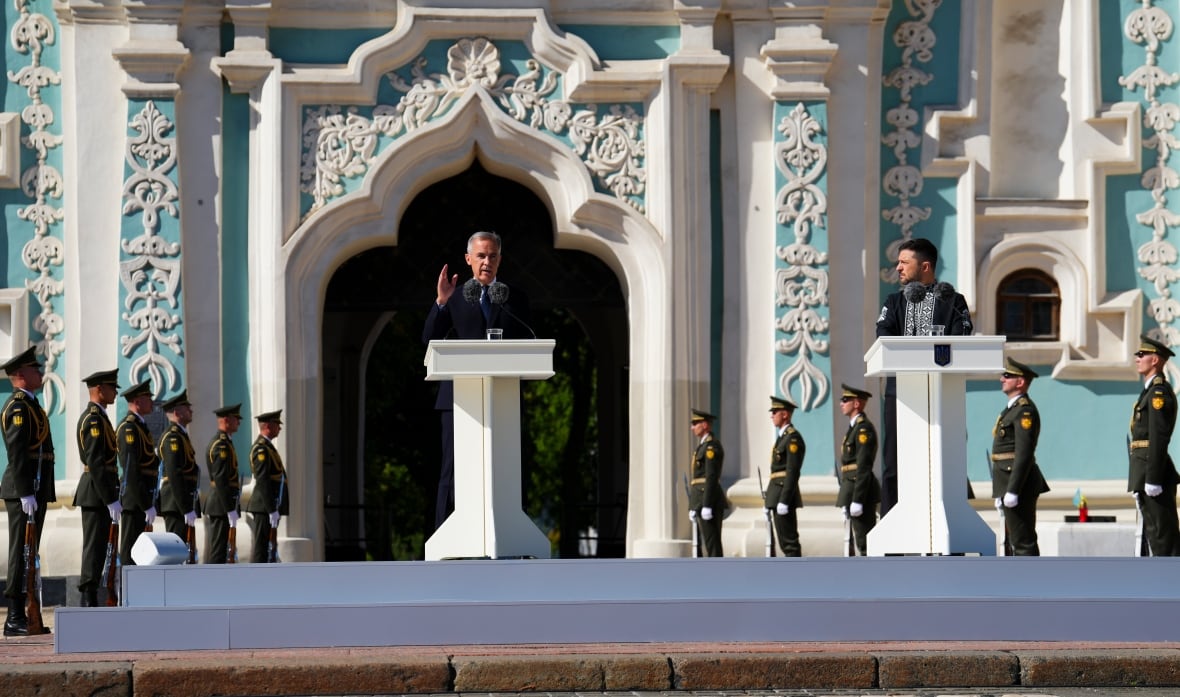
Canada’s PM delivers speech at Ukraine’s independence day celebrations as a ‘special guest,’ officials say.

Prime Minister Mark Carney arrived in Kyiv on Sunday for his first official visit to the war-torn country where the prospects for peace appear as distant as ever despite attempts by the Trump administration to broker a settlement in the war between Ukraine and Russia.
Carney’s trip was made under a strict news blackout and amid tight security as the Ukrainian capital is a frequent target for Russian missile and drone strikes.
His visit coincides with Ukraine’s independence day celebrations and Carney was invited to attend on this day as a “special guest,” according to Canadian officials who briefed journalists about the journey. Ukraine, which has always had its own distinct cultural identity, declared its independence on Aug. 24, 1991, heralding the collapse of the Soviet Union less than six months later.
The prime minister is meeting with Ukrainian President Volodymyr Zelenskyy and the two leaders discussed details of Canada’s additional $2 billion commitment of military aid as well as opportunities for joint production of defence equipment.
In his speech, Carney said more than $1 billion will be used to finance ammunition, as well as advance drone and armoured vehicle production from Canadian suppliers.
The question of security guarantees will also be discussed as part of a broader push by allies toward setting the conditions for possible peace talks, which U.S. President Donald Trump has been trying to facilitate without much visible success.
The lessons of history are obvious, the prime minister said.
“We know that Putin can never be trusted,” Carney said in his speech in historic St. Sophia Square in Kyiv.
“We know that true peace and security will require security guarantees for Ukraine.”
In search of security guarantees
As a hedge against Russia using a possible ceasefire — or peace settlement — as simply a pause between wars, Ukraine is asking allies for concrete guarantees and measures of support.
“Putin has broken his word repeatedly from Minsk to this morning,” Carney said in reference to the two failed attempts at peace brokered in Minsk, Belarus, prior to Russia’s full invasion.
U.S. Secretary of State Marco Rubio recently led a delegation to discuss what allies are prepared to offer in terms of postwar guarantees. He was accompanied by senior American generals and top national security advisers from the U.K., France, Germany, Italy, and Finland and met with Andriy Yermak, the top adviser to Zelenskyy, according to local media reports.
At the same time, NATO Secretary General Mark Rutte was also in Kyiv. He spoke at a recent press conference with Zelenskyy and said the postwar guarantees would consist of two distinct elements — further strengthening the Ukrainian army and deterrence commitments from the U.S. and other allies, including Canada, to prevent future aggression by Russia.
Carney praised Trump’s desire to push for peace, but cautioned the allies need to be prepared for the postwar world.
“When that peace comes, we cannot simply trust and verify, we must deter and fortify,” Carney said.
Obstacles to peace
One of the major stumbling blocks toward peace is the Kremlin’s continued, outright refusal to accept U.S.-backed security guarantees.
In an English-language social media post last week, Dmitry Medvedev, the deputy head of Russia’s security council and the former president, wrote that Russia has categorically stated there should be no NATO involvement in any potential peacekeeping force inside of Ukraine.
Medvedev insisted there’s no need for postwar security guarantees.
Other Russian lawmakers, also last week, suggested Ukraine should follow the Second World War example of Finland, which was invaded by the Soviet Union, and simply ceded territory and became a neutral country, according to the Washington-based Institute for the Study of War, which tracks political and military developments in regular reports.
Russia is demanding Ukraine cede Kherson, Zaporizhzhia, Donetsk, and Luhansk provinces in the south and east of the country.
Joint production
When it comes to the continued armament of Ukraine, Canada recently committed an additional $2 billion in defence aid during the recent G7 Summit in Kananaskis, Alberta.
It has also signed a strategic defence agreement with the European Union, which will facilitate joint purchases and production among allies, including Ukraine.

Carney pledges support for Ukraine to wrap G7
Canada pledged $4.3 billion in support for Ukraine and added sanctions to Russia, as the G7 summit wrapped in Alberta. Prime Minister Mark Carney met with Ukrainian President Volodymyr Zelenskyy on the summit’s final day.
At the time of the signing, drones were mentioned as a possible area of co-operation between Canada and Ukraine, given that country’s stunning and innovative use of the remotely controlled technology.
Last week, the United States and Ukraine announced a $50 billion drone co-operation initiative, one of the largest strategic commitments between the two nations.
Because Ukraine needs every piece of military equipment at the front, the country prohibits defence exports to other countries.
Ukraine’s Arms Monitor, an online digest that tracks equipment related to the war, reported last week that Ukrainian officials, under pressure from the domestic industry, are considering slightly relaxing the restriction, but only for the most trusted allies — likely NATO members — who have the capacity to safeguard sensitive technology.
ABOUT THE AUTHOR

Senior reporter, defence and security
Murray Brewster is senior defence writer for CBC News, based in Ottawa. He has covered the Canadian military and foreign policy from Parliament Hill for over a decade. Among other assignments, he spent a total of 15 months on the ground covering the Afghan war for The Canadian Press. Prior to that, he covered defence issues and politics for CP in Nova Scotia for 11 years and was bureau chief for Standard Broadcast News in Ottawa.
*****
Credit belongs to : www.cbc.ca


