 Atin Ito | Ontario’s First Filipino Community Newspaper – Trusted News and Stories for the Filipino-Canadian Community Atin Ito is Ontario’s first Filipino community newspaper, delivering trusted news, stories, and updates for Filipino-Canadians. Stay connected with your community.

‘Our lives have been destroyed,’ says Palestinian father at Al-Quds hospital where his family is staying.

In Gaza City, the Al-Quds hospital still stands along the once vibrant Tal el Hawa road. Though its windows have been blown out and parts of its sign are missing, the hospital is still a beacon for those seeking treatment and shelter.
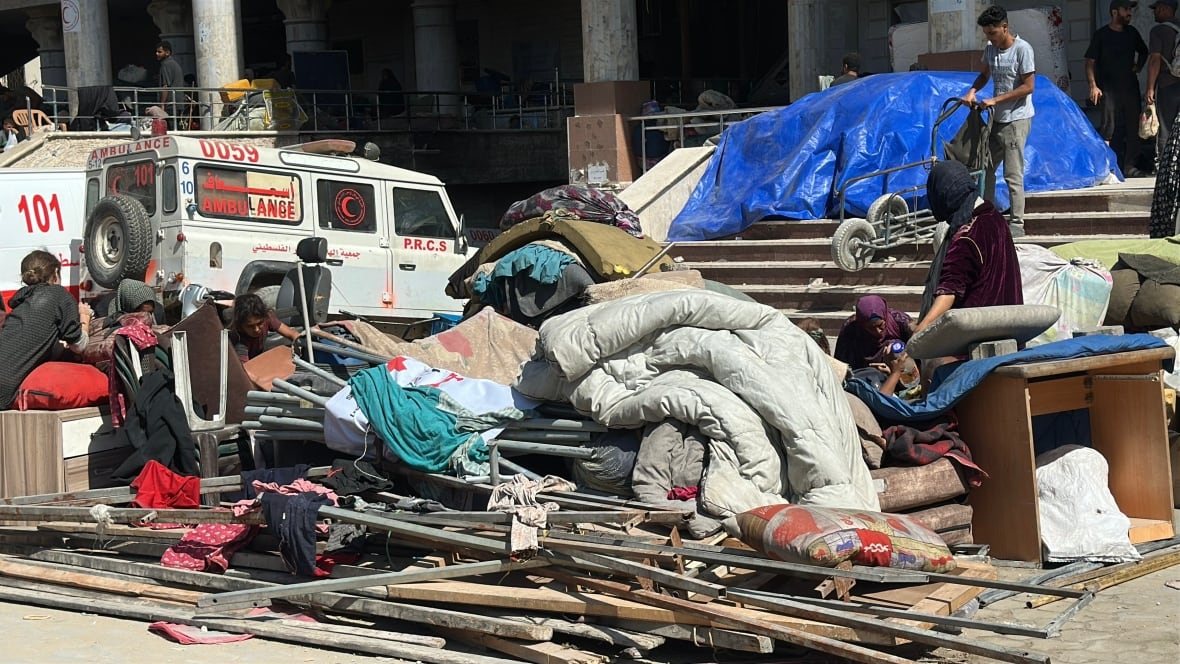
Between ambulances waiting on the parking ramp, personal items belonging to those who’ve been displaced litter the road — blankets, mats and wood, lots of wood.
The street was once one of Gaza’s busiest, but after almost three years of war, much of it is rubble and the buildings that remain are little more than shells.
Palestinians have had to find different ways of seeking shelter in Gaza, and many are now living outside the hospital in the hopes that it will protect them from bombs and rockets.
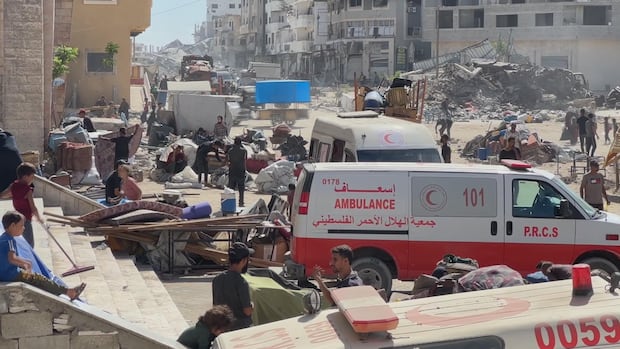
Palestinians shelter near hospital in Gaza City hoping for safety
Displaced families are living outside Al-Quds hospital in Gaza City hoping for protection from bombs and rockets. But, as they tell CBC freelance videographer Mohamed El Saife, even there they can’t escape the danger.
During the last ceasefire, Israel had pulled out of the northern region, allowing residents to return.
Earlier this month, Prime Minister Benjamin Netanyahu announced that Israel would increase its ground offensive in Gaza City, and the Israeli Defence Forces (IDF) dropped leaflets telling Palestinians to leave the area.
And though thousands of Palestinians are fleeing the north, UN Palestinian relief agency UNRWA recently noted that a journey south could cost an average of $3,000, a price many cannot afford after months of war.
Some families sheltering at the hospital also say they’ve been displaced many times before and fear that no place in Gaza is safe.
Families say they can’t afford to flee
Hala Abu Hanider and her four daughters are among the families who are sheltering near the entrance of Al-Quds where her husband is a patient. She says she doesn’t have enough money to go south with her children.
“As you can see, people are in the street [and] I am here, waiting,” she told CBC News freelance videographer Mohamed El Saife. “Either they come in and kill us or they move us to another area.”
In another part of the hospital, Mahmoud Halas says he was recently displaced from the school where he was sheltering with his family.
“No one is paying attention to us, not even an Arab country,” he said. “Everyone only cares about themselves.”
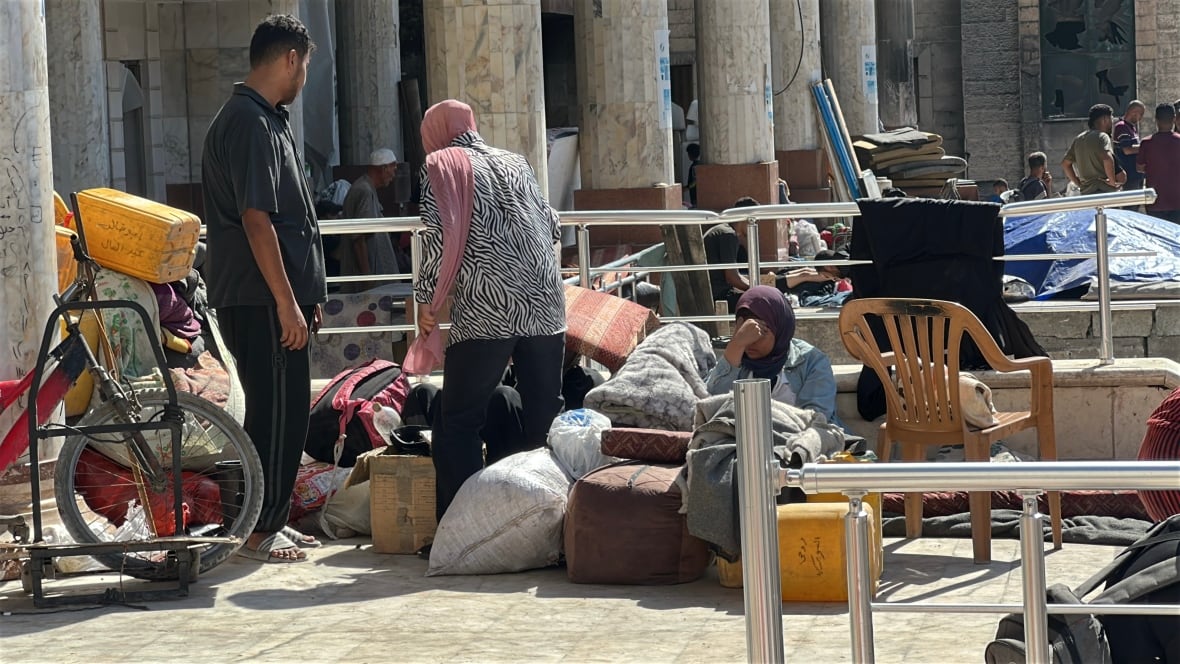
Halas says he arrived at Al-Quds earlier this week after quadcopters — drones equipped with guns — surrounded the school he was in and shot at it. But even here at the hospital, he says he can’t escape the bombs.
“Every day, bombs and quadcopters come, planes come and drop bombs and rockets,” he said, as he rushed down the stairs of the hospital’s main entrance to show the area under the steps where he and his children are sheltering.
“This is where our things are,” he said, pointing to a meagre pile of mats, blankets and other items he’s collected during various displacements.
“Our lives have been destroyed.”
UN experts call Israeli hospital attacks ‘medicide’
Many families in Gaza believe that hospitals are safe places during times of war, which is why they’re trying to stay in or near them.
According to the International Committee of the Red Cross, international humanitarian law states that targeting hospitals and schools during armed conflicts goes against the rules of engagement.
Under International Humanitarian Law the principle is clear: Hospitals are protected, because of their life-saving function for wounded. Yes, they can lose their protection, but this is not a free license to attack. @ICRC
But Israeli strikes and raids on health facilities are not uncommon, and multiple hospitals across the strip have been struck or bombed. Israel says its attacks target militants they say are using health facilities as cover for bases, something both Hamas officials and medical staff deny.
In an August statement, the UN noted that the World Health Organization (WHO) has reported 735 attacks on health care in the strip since Oct. 7, 2023, affecting 125 health facilities and damaging 34 hospitals.
In the same statement, UN experts accused Israel of medicide, saying it was deliberately attacking and starving health-care workers, paramedics and hospitals to wipe out medical care in the enclave.
“In addition to bearing witness to an ongoing genocide we are also bearing witness to a ‘medicide,’ ” the experts said, calling it a “sinister component” meant to intentionally create conditions that would “destroy Palestinians in Gaza.”
Earlier this month, a United Nations Commission of Inquiry in Geneva concluded that Israel had committed a genocide in Gaza. Israel denied this, calling the accusations “scandalous” and “fake.”
The breaking point
Abu Yamen Marouf says he and others waiting outside Al-Quds are reaching a breaking point.
With much of the north destroyed, they say leaving the hospital grounds would leave them more vulnerable to the fighting.
“So waiting here for the tank to kill me is more honourable,” Marouf said.
Halas admits he’s scared for himself and his children.
“We just want the war to end so we can live any life,” he said. “Just stop the war.”
ABOUT THE AUTHOR

Producer
Yasmine Hassan is a producer in CBC’s Ottawa bureau. From there, she covers developments inside Gaza and the West Bank related to the Israel-Hamas war. If you have a story idea, send news tips in English or Arabic to yasmine.hassan@cbc.ca.
With files from Mohamed El Saife
*****
Credit belongs to : www.cbc.ca


