 Atin Ito | Ontario’s First Filipino Community Newspaper – Trusted News and Stories for the Filipino-Canadian Community Atin Ito is Ontario’s first Filipino community newspaper, delivering trusted news, stories, and updates for Filipino-Canadians. Stay connected with your community.

Foreign Secretary Theresa Lazaro says the Philippines will uphold international law while pursuing diplomacy and defense modernization
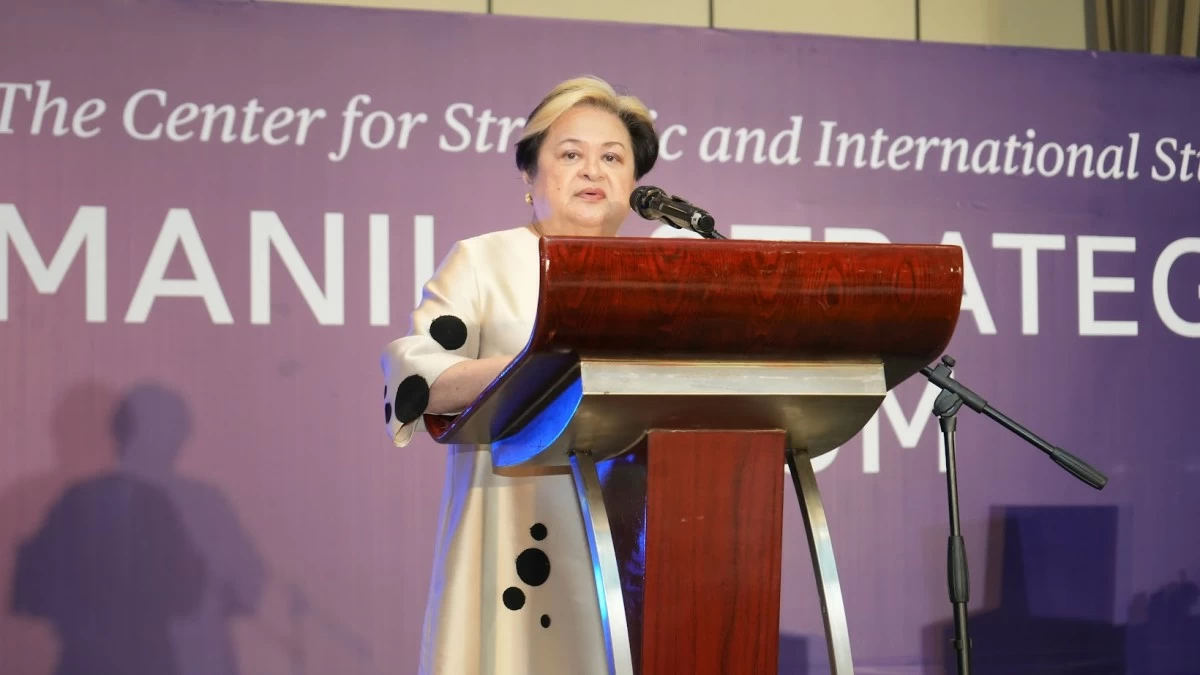 Foreign Secretary Theresa Lazaro delivers her keynote address at the Second Manila Strategy Forum on Sept. 9, 2026. (Photo: DFA-OPD Camille Barizo)
The Philippines will continue to defend its sovereignty and maritime rights while avoiding confrontation and escalation, Department of Foreign Affairs (DFA) Secretary Theresa Lazaro said Wednesday, Sept. 9, as regional tensions persist in the South China Sea.
“Our posture in the West Philippine Sea and the wider South China Sea exemplifies this principle,” Lazaro said.
Lazaro stressed that these legal foundations would not be used as bargaining tools.
PH seeks diplomacy, but rejects coercion
“We seek neither confrontation nor escalation, but we will not succumb to coercion,” she said.
“We counter assertiveness with legal clarity, credible defense modernization, and persistent diplomatic engagement,” Lazaro said.
Lazaro highlighted that international law remains a crucial safeguard for smaller and developing countries, stressing that it allows sovereign states to assert their rights amid growing geopolitical tensions.
Strategic resilience
She noted that the Philippines needs to build “strategic resilience” to anticipate disruptions, absorb external shocks, protect its interests and expand its diplomatic options.
“Our reality demands far more than crisis management,” Lazaro added. “It demands strategic resilience.”
She cited the Philippines’ alliance with the United States, noting that the two countries are marking 80 years of diplomatic relations and 75 years of their Mutual Defense Treaty this year.
“National security and economic security are inseparable: to be security strong, the Philippines must be economically strong,” Lazaro said.
Lazaro said the Philippines is also strengthening ties with Japan, Australia, Canada, South Korea, New Zealand and other partners while expanding its diplomatic engagement in Europe, South and Central Asia, the Middle East, Latin America and Africa.
“A nation with diversified relationships possesses greater diplomatic maneuverability,” Lazaro said.
“We remain open to constructive dialogue with China wherever mutual benefit and sovereign equality allow, while remaining uncompromising in the defense of our sovereignty, sovereign rights, and jurisdiction,” she said.
Lazaro also highlighted the Philippines’ role as ASEAN chair this year, saying Manila wants to strengthen the regional bloc’s centrality amid growing geopolitical competition.
She said the Philippines’ ASEAN chairmanship is focused on three priorities: establishing peace and security anchors, creating prosperity corridors, and championing people empowerment.
“The ultimate benchmark of our foreign policy is straightforward. Does it deliver for the Filipino people?” she said.
“This is why we invest in strategic resilience,” Lazaro said. “We do so to guarantee that the Philippines remains the master of its own destiny, secure in its territory, competitive in its economy, and steadfast in its values,” she added.
— Merlina Hernando-Malipot
*****
Credit belongs to: www.mb.com.ph


